"5 m tape measure" is not a complete product specification. A supplier still needs the blade width, model, lock requirement, quantity, scale, logo, and packaging. Two tapes with the same nominal length can follow different product routes.
Quick answer
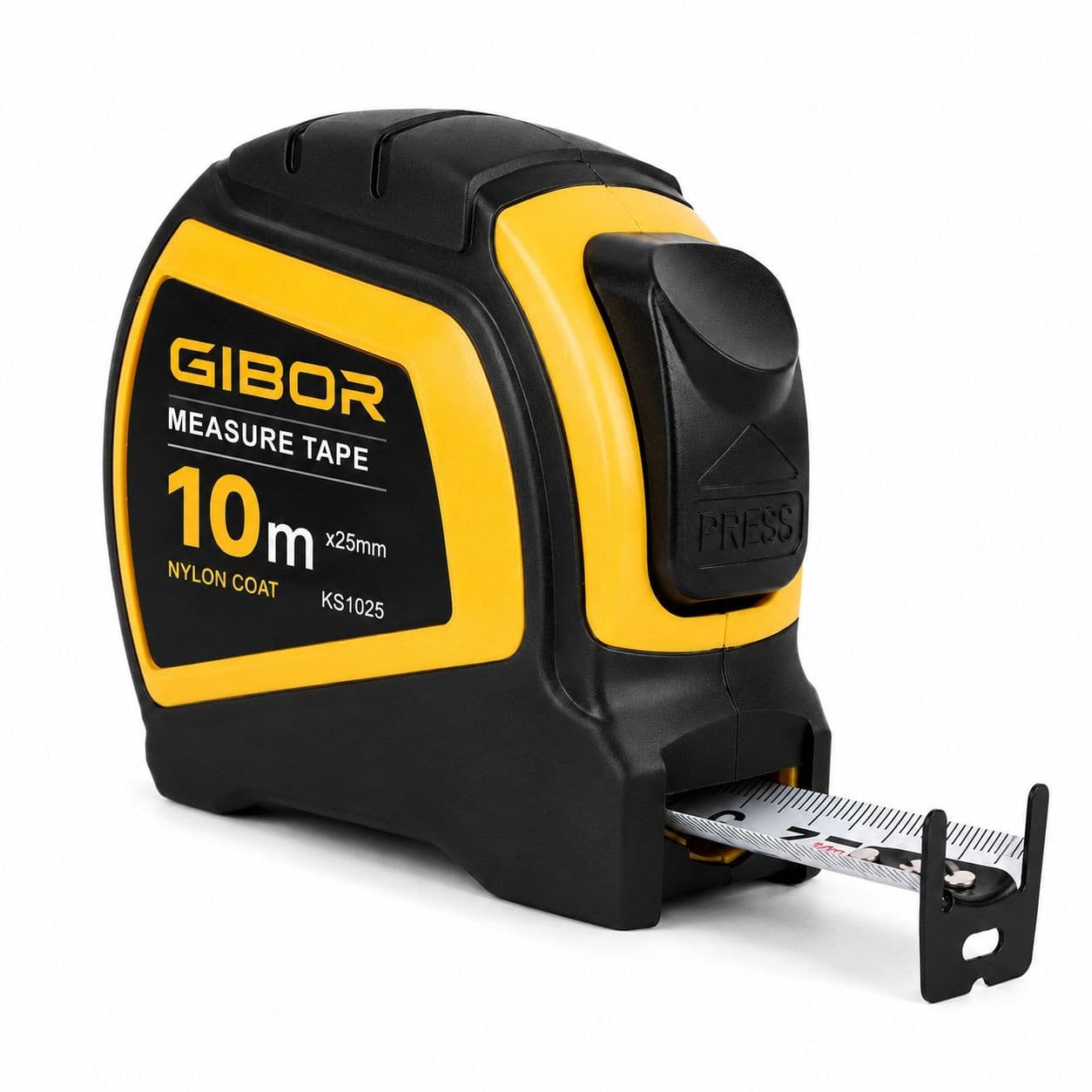
GIBOR's confirmed handheld range covers 3 m, 5 m, 7.5 m, and 10 m Class II options. A 19 mm or 25 mm blade can be discussed for 3 m and 5 m projects. The confirmed 7.5 m and 10 m options use a 25 mm blade. Final availability is checked against the selected model.
| Length | Available blade widths | Accuracy | Buyer planning note |
|---|---|---|---|
| 3 m (10 ft) | 19 mm (3/4 in) or 25 mm (1 in) | Class II | Short handheld length; compare case handling and required standout on the actual model. |
| 5 m (16 ft) | 19 mm (3/4 in) or 25 mm (1 in) | Class II | Compare the available models by blade width, lock function, handling and standout. |
| 7.5 m (25 ft) | 25 mm (1 in) | Class II | Longer handheld reach with the currently confirmed 25 mm blade option. |
| 10 m (33 ft) | 25 mm (1 in) | Class II | Longest confirmed handheld length; check case handling and return action on the sample. |
Imperial values are rounded buyer references, not separate nominal specifications. The table is a supply range, not a promise that every model supports every combination.
1. Confirm length and width together
Length tells the buyer how far the tape can measure. Blade width helps identify the available model, but it must be matched with the case, spring, lock design, and packaging. A 25 mm blade in a 3 m or 5 m tape may use a different case size and weight from a 19 mm model.
Compare the actual sample for grip, portability, and handling instead of choosing by width alone. State both values in the RFQ so the supplier can select a relevant model before quoting.
2. Standout matters, but it must be checked by model
Standout is the unsupported distance a blade can extend before it bends or collapses. With similar blade material, curvature, thickness, and construction, a wider blade will usually have better standout. Width is still only one factor, so a generic distance from another product is not reliable.
Use the physical sample to compare standout, product feel, and operation. A wider blade does not automatically make a tape more accurate or better for every market. The confirmed handheld range is Class II, and accuracy is checked separately from blade width, lock, case, coating, and packaging.
3. Locking function depends on the model
Not every handheld tape uses the same lock. Some models support a manual or self-locking function; other models use a different operating design. State the required lock before model selection, or ask the supplier to recommend a model when there is no fixed preference.
4. Packaging starts neutral and can be customized
Neutral packaging is the default. Custom packaging can be discussed when the order needs branded presentation, labels, artwork, barcodes, or carton marks. Fix the length, blade width, and model first, then approve packaging against that product.
5. What to check on a sample
Confirm the nominal length and blade width on the selected model.
Check the scale layout, readability, and agreed Class II specification.
Review the hook condition and blade return action.
Test the lock when the selected model includes one.
Compare standout using the same test position and method for each sample.
Confirm case handling, logo position, and neutral or custom packaging details.
The sample confirms one selected model. It should not be treated as proof that every model uses the same lock, case, standout, or packaging.
6. Send a usable RFQ
These details are enough for GIBOR to match the request to a relevant Class II handheld model and confirm the next quotation or sample step.
Required length: 3 m / 5 m / 7.5 m / 10 m
Required blade width: 19 mm / 25 mm
Lock preference: manual lock / self-lock / supplier recommendation
Scale: metric / imperial / dual
Quantity:
Logo requirement:
Packaging: neutral / custom
Destination market and buyer type:
Message:
Handheld tape RFQ
Send the length, blade width, lock preference, quantity, scale, logo, and packaging.
GIBOR will check a relevant Class II model before quotation or sample approval.